Posts
Force-Torque real-time graphics
The captured data is composed by: 3 Forces at the fist (3 axis) 3 Torques at the fist (3 axis) 6 Torques at the joints (6 joint efforts) 1 Current of gripper fingers This means that we can get 13 values of Force/Torque at each defined timestamp.
Gripper Status decoded

Gripper used: ROBOTIQ 2F-140 According to the Instruction Manual of the gripper (pages 38-70), I created a Gripper Status Class (DTO), with all the properties that can be read from the RS485 communication between the computer and the gripper driver. Then I read every bytes (and its bits) to translate the meaning of every status message. The leading translation was built upon pages 44, 45, and 46 of the Gripper Instructions Manual . The image above shows almost every field of this Gripper Status message. The Object Detected boolean property is not printed on this image. The gripper has 3 main statuses : activated reset automatic release Automatic Release is a specific command that should be sent to the gripper whenever the robot feels some kind of fault/error. This command will slowly open (or close - the user can choose) the fingers until the limited position. Every time Automatic Release is commanded, the gripper needs to be re-activated to work properly...
RobotIQ gripper force test experiment #1
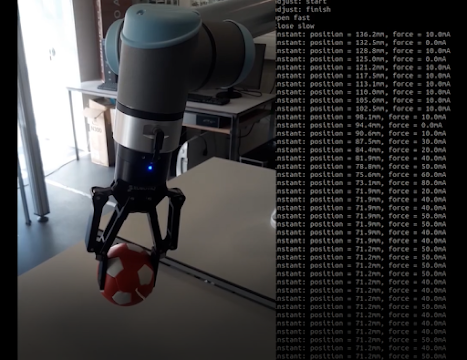
For a better understanding of how does the force value work and what it really translates, I performed a simple test: Requested to completely close the gripper , at the lower possible speed . At the same time, I requested the instant status ( position and force ) from the gripper. This status request was made at 10 Hz (10 times per second). I did this test twice: Without any object (two gripper fingers touching each other) With a soft red ball that can be squeezed (to check for force values variance) The result showed a high value of force right before the last gripper fingers position, both when there was no object and when the robot grabbed the soft red ball. After this force high value, the gripper has become stable, not moving its fingers anymore and holding the same force value for the rest of the time. We can see the results in this small video:
RobotIQ Gripper Force values

Gripper Status Closed Gripper Gripper holding wood-block (pose #1) Gripper holding wood-block (pose #2) Gripper holding wood-block (pose #3) Gripper holding tennis ball My conclusion: This 'force' value has nothing to do with the shape, weight and/or pose of the object that it is being hold Furthermore, this 'force' value does not respond to any perturbations during the object holding (I tried it myself)